Your dreams, understood.
Dream interpretation from within your own tradition: write down your dream, read what it means, and keep it in your Dream Book.
What does your dream mean?
Write your own dream and get an interpretation straight away. Free, no account.
You already have an account. Write your dream in the app: it goes straight into your Dream Book, read within your tradition.
Write your dream in the app
- On Android
- Your dreams stay private
- Free to try
- From several traditions
How Dreamkin works
-
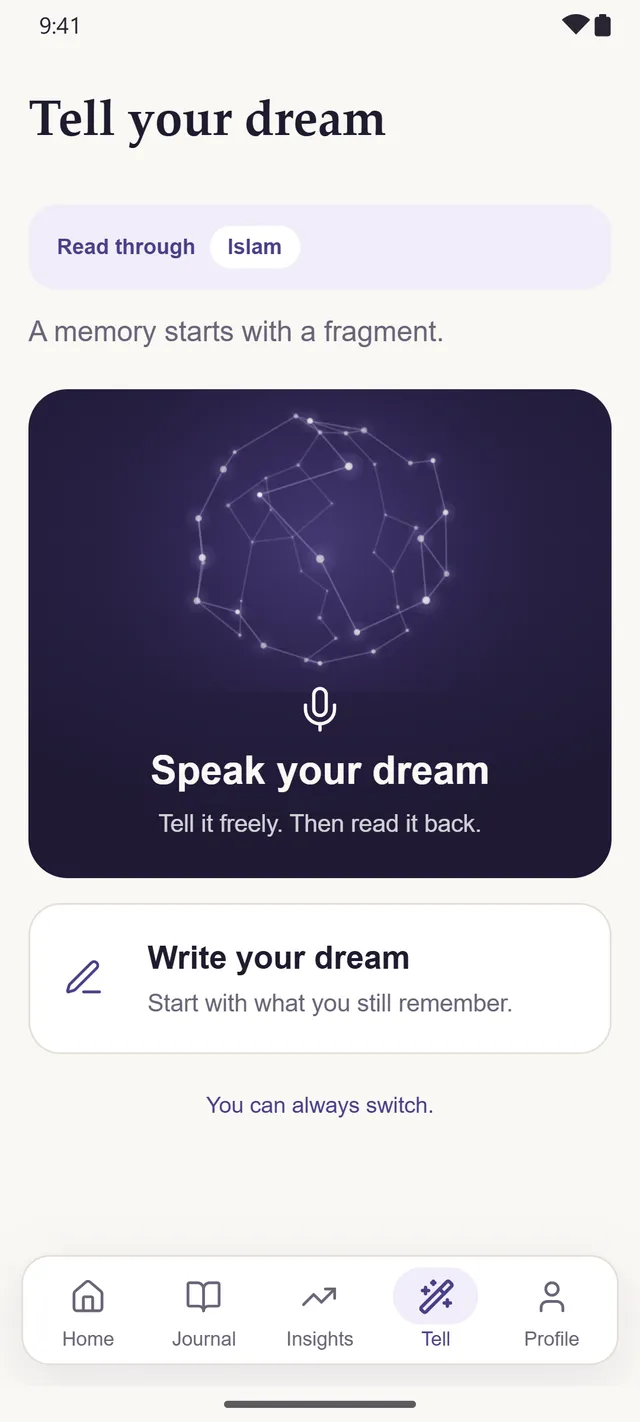
01 Write it down
Type or speak your dream, right after you wake up.
-
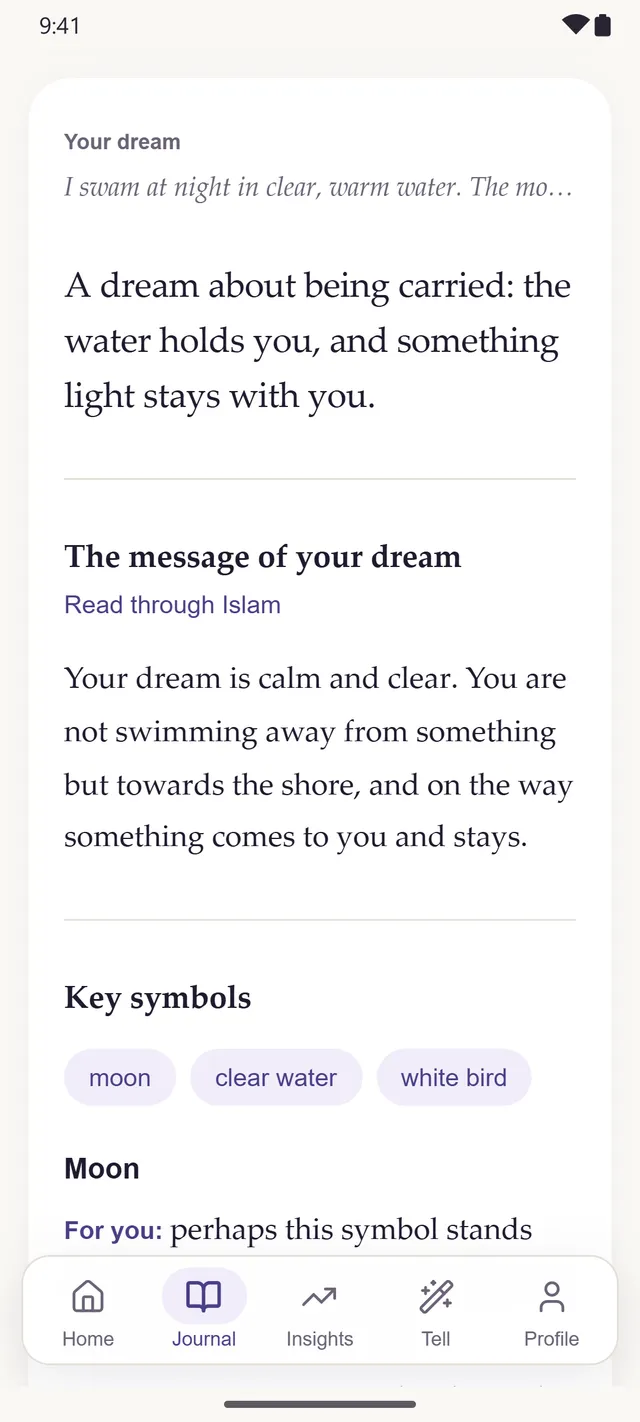
02 Understand
Read what it means, from the tradition that matters to you.
-
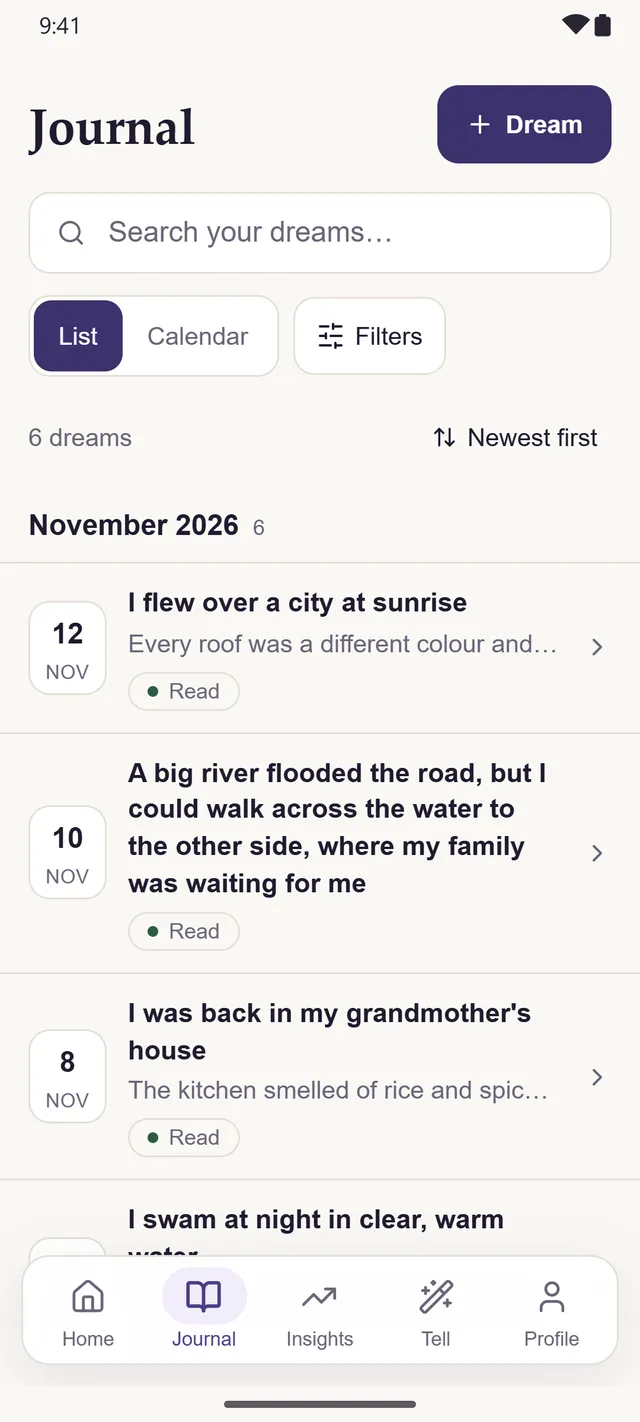
03 Remember
Your Dream Book keeps your dreams and shows what comes back.
This dream in 11 traditions
My grandmother stood in the doorway and said my name.
In almost no other tradition is this dream taken as directly and as seriously as in Winti. When a deceased loved one appears, it is generally read as a yorka visit.
Read the full Winti interpretation →Dreaming of someone who has died is taken seriously in the Islamic tradition, but read differently than in traditions treating it as direct contact.
Read the full Islamic interpretation →Dreaming of someone who has died is among the most meaningful dreams in Santería: it is read as contact with the egun.
Read the full Santería interpretation →Dreams of the deceased are common in the Christian tradition and rarely waved away, but most strands are careful with the idea that it is genuinely contact.
Read the full Christian interpretation →In Wicca a dream about someone who has died is taken seriously, and the time of year weighs heavily.
Read the full Wicca interpretation →In Hinduism a dream about a loved one who has died is usually read in the light of the ancestors, the pitri. There is no single meaning: the Garuda Purana sees a dead relative asking for food as someone not yet at rest, while the Brahmavaivarta Purana counts seeing a dead person among the favourable dreams.
Read the full Hindu interpretation →In many Buddhist traditions the living can still do something for their departed loved ones: dedicate merit to them. A dream about a deceased person is therefore often read as an invitation to remember them and wish them well.
Read the full Buddhist interpretation →In Judaism the dead remain connected with the living through remembrance: the Kaddish, the yahrzeit and visits to the grave. A dream about a loved one who has died is often read as part of grief and memory.
Read the full Jewish interpretation →In the Akan tradition the dead are not gone: they become nsamanfo, ancestors, who counsel, warn and protect the family. A dream about a deceased loved one is therefore read seriously and warmly, as a visit or counsel.
Read the full Akan interpretation →In Haitian Vodou the dead remain part of the family. The lemò, the ancestors, are served and remembered, and dreams about the dead are often seen as real contact. An ancestor may come to give counsel, warn or ask for something.
Read the full Vodou interpretation →Within Spiritism there is the belief that spirits can meet one another in sleep, including those of people who have died. Kardec himself adds that many such dreams are memory and longing, and that a dream proves nothing.
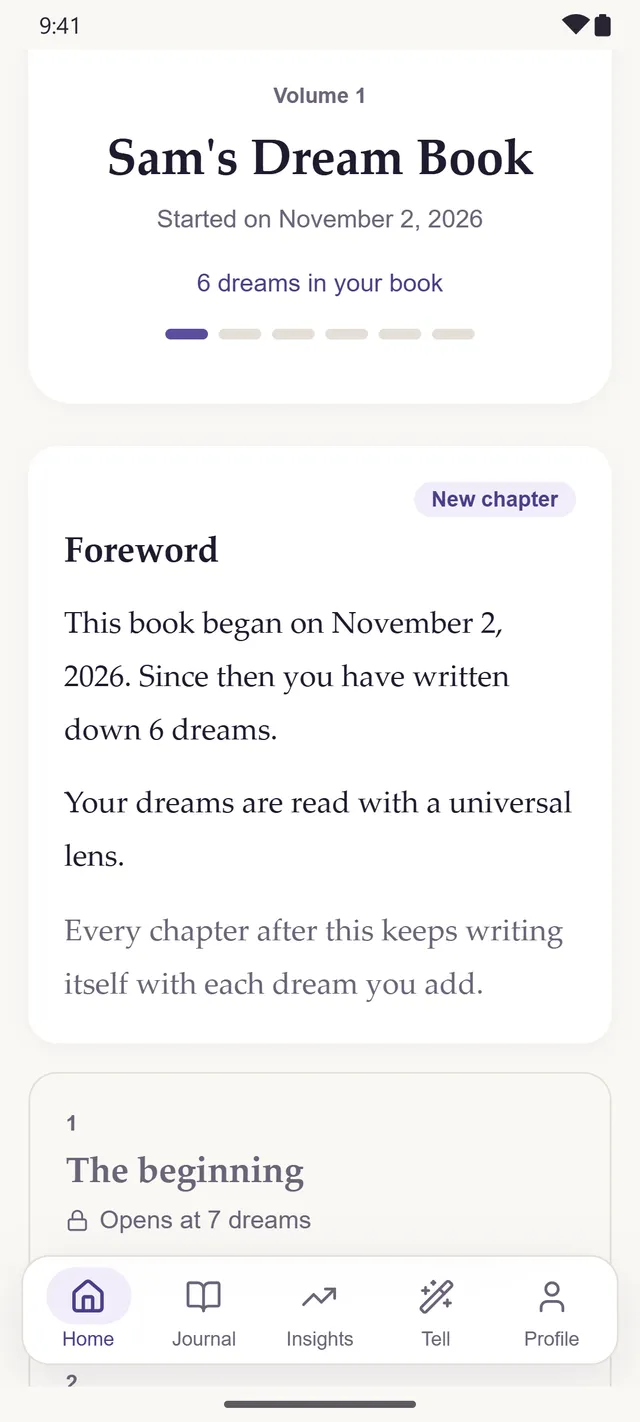
Read the full Spiritism interpretation →Your Dream Book
All your dreams in one place, private. The longer you keep it, the more you see what comes back.
- Search all your dreams
- Recurring symbols
- Readings from your tradition
Library
Read more about dream symbols, traditions and what dreams mean.
Traditions
- AkanIn the Akan tradition of Ghana dreams are a recognised channel between the living, the ancestors and the spirit world. During sleep the sunsum, a person's spirit, is said to travel and meet.
- Bahá'íThe Bahá'í writings contain no dream dictionary. What they do contain is about the spirit, sleep and the difference between genuine spiritual insight and imagination. So Dreamkin does not explain images and asks questions instead.
- BuddhistIn Buddhism a dream above all shows the mind itself: what it clings to, what it fears and what it holds on to. The classical texts are sober about prophetic dreams, and the Tibetan tradition even uses the dream as a place of practice.
- CandombléIn Candomblé a house, the terreiro, understands dreams in relation: to the dreamer, to the house and to the pai or mãe de santo. A list of symbols does not exist, and Dreamkin does not make one.
- Zhou GongThe Chinese dream tradition is thousands of years old. The best-known dream book, the Zhou Gong Jie Meng, is still consulted today. Many readings are surprisingly favourable and play on sounds: fish means abundance, water stands for wealth.
- ChristianIn the Christian tradition dreams appear throughout the Bible as a means of guidance, warning and comfort.
- HinduIn Hinduism dreaming is a state of consciousness of its own, svapna, which the Upanishads already reflected on. Dreams can arise from the body and the day, but also from karma, from the ancestors or from the divine.
- IslamicIslamic dream interpretation, ta'bir al-ru'ya, has a tradition over a thousand years old, with Ibn Sirin its best-known name.
- JewishIn Judaism dreams have a long history, from Jacob's ladder and Joseph's dreams to a whole chapter in the Talmud. A dream counts there as one-sixtieth of prophecy: sometimes meaningful, often simply the thoughts of your own heart.
- SanteríaIn Santería, also called Regla de Ocha or Lucumí, dreams are read through the energy of the Orishas and the presence of the ancestors.
- ShintoShinto has no dream book and no dream doctrine of its own. What does exist is a Japanese dream culture in which belief in kami, Buddhism and folk custom run together. Here is how that culture looks at dreams.
- SpiritismSpiritism, the doctrine Allan Kardec wrote down in the nineteenth century, has its own view of dreams: within it there is the belief that during sleep the spirit partly frees itself from the body. Kardec himself warns at the same time that most dreams are not messages.
- VodouIn Haitian Vodou dreams are one of the main ways the lwa and the ancestors speak with the living. A dream is therefore read not only as symbol, but as a possible visit: who is coming, and what is being asked?
- WiccaIn Wicca and nature-based practice, dreams are read through the elements, the moon's phase and the wheel of the year.
- WintiWinti is the Surinamese spiritual tradition in which dreams are one of the ways the ancestors and the winti speak to the living.
Commonly searched symbols
Dream interpretation used to be personal.
A grandmother.
An imam.
A wintiman.
Someone in your family who knew you, and knew your tradition.
Through migration, secularisation and distance, that person has fallen away for many people. Dreamkin brings that perspective back.
Questions about dream interpretation
Which app tells you what your dream means?
Dreamkin reads your dream within the tradition that matters to you, such as Islam, Christianity, Winti or Hinduism, where most dream apps give one general meaning, often from Western psychology. It works in your browser with nothing to install, and your first reading needs no account. Our comparison of dream apps sets the options side by side.
Can AI or ChatGPT interpret dreams?
A language model can apply a described frame to your dream well, but without one ChatGPT tends to answer in general terms and may mix traditions. Dreamkin also uses AI, but gives it the tradition you choose and firm rules: describe rather than prescribe, and no predictions of illness, death or misfortune. How we work explains what is AI and what is written source.
What is the best dream journal app?
The best dream journal is the one you actually keep. In Dreamkin every dream becomes part of your Dream Book: recurring symbols surface on their own, and a free account gives three full readings a week, with no ads.
How do I find out what my dream means?
Write it down as soon as you wake, with who was there and how it felt, and ask what in your life it touches. Then look at the main image within your own tradition, for example in the dream symbols, and talk it over with someone who knows you and your tradition.
Is keeping a dream journal worth it?
For most people, yes: dream researchers have long found that people who write their dreams down remember more of them over time, and recurring images become visible. Our guide on how to remember your dreams has practical tips.
Do we forget 90% of our dreams?
That figure is repeated often but is hard to trace to a specific study, so we do not state it as fact. What is well established: a dream fades quickly once the day begins, and writing it down right away is the simplest way to keep it.